
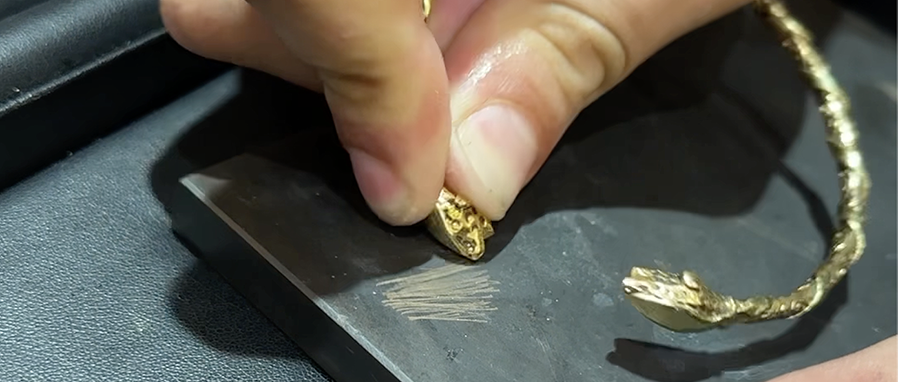
Do you own gold jewelry (rings, necklaces, bracelets...) but don't know if it's gold or just gold-plated? The difference can sometimes be difficult for the untrained eye to discern. Gemme Jewelry explains the methods used in the workshop or at home to distinguish real gold jewelry from plated jewelry.
Gold and Gold Plated: Differences and Characteristics
Plated jewelry is jewelry made of a material other than gold (steel, copper, nickel, silver, etc.), but covered with a thin layer of gold. The plating technique is based on electrolysis. It is also called rolling, electroplating, or gilding.
Gold plating tends to tarnish over time when exposed to skin acidity or cosmetics. The different plating qualities are expressed in microns, with 1 micron corresponding to a layer of gilding 0.001 mm thick. For a piece of jewelry to be sold as "gold-plated," it must be plated with 3 microns of gold.
Gold jewelry, on the other hand, is made from an alloy that contains gold, in a variable proportion expressed in carats:
• 24 carats for a composition of 99.9% gold, also called "fine gold"
• 18 carats for 75% gold
• 14 carats for 58.5% gold
• 9 carats for 37.5% gold
The percentage can be expressed in thousandths, for example, "750 gold" for 750 thousandths (18 carats).
Note: 24-carat gold is rarely used in jewelry due to its malleability and softness. The most precious jewelry is therefore made from 18-carat gold: the composition that offers the best compromise between the nobility of gold and the strength of another material such as silver, copper, zinc, or palladium.
What methods can be used to distinguish gold from gold-plated metal?
Hallmarks
A simple magnifying glass can help you identify the hallmark on a piece of jewelry, which certifies its gold content. :
• The eagle's head for 18 carat gold
• The shell Scallops for 14-karat gold
• The clover for 9-carat gold, the "ET" mark for an alloy containing less than 375 thousandths of gold.
The presence of a master's mark, recognizable by its diamond shape, is a guarantee of value: it indicates that the jewel comes from a major jewelry house. It cannot therefore be gold-plated.
There are also specific hallmarks to distinguish gold-plated:
• The square
• Registration Oria
• The Fox inscription
• Registration Muraty
• The inscription "metal doré"
Gold-plated silver, also known as "vermeil," is stamped with a "v" in a diamond. The thickness of the plating can then be up to 5 microns.
Finally, the "3M" mark certifies that the plating is indeed composed of 3 microns of gold, which corresponds to the European standard for jewelry.
Visual, physical, and chemical tests
Various tests can distinguish alloys containing gold from metal that is simply gold-plated. The appearance of the jewelry can first inform you: if any loss of gold is visible, it means it is plated. Precious metals do not attract magnets, so you can hold a magnet close to your jewelry to check that it is not made of steel.
Other tests are used to identify gold:
• density
• thermal conductivity
• that of nitric acid
But either their implementation requires specific equipment, or the interpretation of their results requires prior expertise.
Jewelry Expertise
Using jewelers' expertise to identify the gold content of a piece of jewelry is the most reliable solution. The knowledge, experience, and equipment professionals rely on ensure unambiguous identification of 18-karat gold plating or alloy. You can obtain an estimate of the value of your jewelry based on its gold content, but also on its jewelry quality, condition, and style.
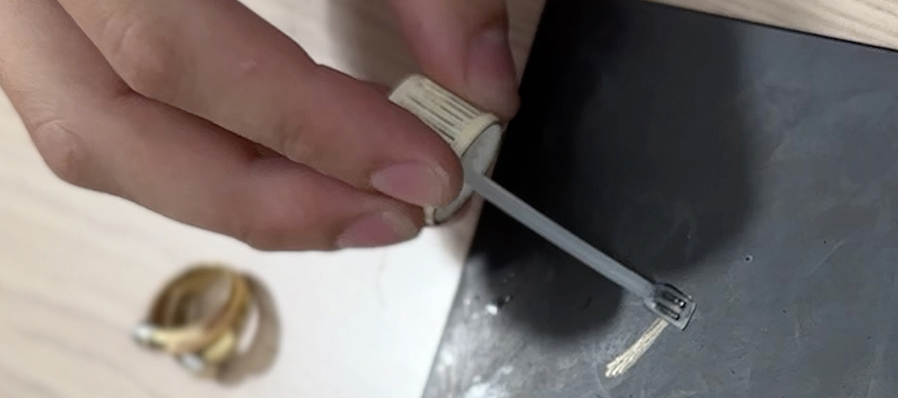
Price difference between gold and gold-plated jewelry
The presence of small quantities of gold justifies the price of a plated piece of jewelry being indexed to the price of gold. It is therefore also variable, just like an 18-karat gold piece. However, its value is considerably lower.
With an equivalent aesthetic, a gold-plated ring can be worth up to 90% less than an 18-karat gold ring.
The price of gold-plated jewelry can, however, also vary depending on the thickness of the plating: vermeil, which can be up to 5 microns of gold plating, is therefore more expensive. The metal on which the gold is plated also plays a role in the jewelry's valuation. For vermeil, again, it is fine silver: the jewelry will be more expensive than if it were made of gold-plated brass.
Unlike the value of a gold jewelry, the value of a plated jewelry varies little depending on the carat used. Indeed, it is common for the higher the carat, the thinner the plating, which equalizes the quantity of gold used.
Do you want to have an antique piece of jewelry appraised or sell an 18-carat gold piece? Gemme Jewelry offers you a free appraisal of your precious jewelry with a buy-back value.
Want to sell a piece of rose gold jewelry and want to know its value? Read our article.