

Do you think you own an antique ring and would like to have it authenticated? Are you looking to have a ring from the 18th century, 19th century, or the first half of the 20th century appraised? The appraisal of antique jewelry is based on several criteria: the period, the style, the quality, the value of the materials used, and the current market value. It therefore remains a complex exercise that requires specific expertise.
Determining the Period and Style
Understanding the history of the ring is essential to accurately assess its value. This involves identifying the style, period, geographical origin, and likely maker. Our gemology experts, trained in the history of jewelry art, identify various clues to authenticate and estimate the price of an antique ring:
The identification of leucosapphire (replacing diamonds) or synthetic sapphire, common on Art Deco style jewelry, gives an indication of the period.
Certain guarantee hallmarks allow the identification of a country of origin.
For example:
• The mule's head for Morocco
• The owl's head for jewelry of uncertain foreign origin
Knowledge of the different hallmarks also helps in dating antique rings.
Certain figures, in fact, were only used during a very specific period:
• Between 1819 and 1838 for the ram's head hallmark guaranteeing a 750 gold ring
• Between 1838 and 1893 for imported gold jewelry marked with the weevil hallmark
• Between 1832 and 1962 for the horse's head hallmark (750/000 gold), the boar's head hallmark (800 thousandths silver jewelry created in Paris), and the crab hallmark (800 thousandths silver jewelry created in the provinces)
• After 1911 for jewelry bearing the rhinoceros or dog's head hallmark (950 platinum)
Many other hallmarks, corresponding to corporations and production cities, allow us to identify older jewelry, dating from before the Revolution.
Observing jewelry techniques also provides indications of the jewelry's age: antique rings thus feature old-cut or rose-cut stones, held in place by very small prongs on the edges.
Certain aesthetics are finally typical of an era, like the tank rings of the 1940s and 1950s, the graphics of Art Deco rings, the ornaments of Art Nouveau rings.
Assessing the Quality
To appraise an antique ring at its current value, it is necessary to assess its original quality as well as its state of preservation. The integrity of the jewelry must be analyzed: has the ring been restored? Have any elements been changed? Is the stone that adorns it original? Authentic or fake?
The purpose of examining the ring by expert jewelers in antique jewelry is to identify signs of wear, deformation, or alteration.
In particular, it is important to study and verify:
• That it has not already been resized
• That the ring is not damaged by prolonged wear of another ring
• That the stone is not chipped
Examine the different types of materials
The value of an antique ring also depends, of course, on the value of the materials it is made of. Examining them carefully allows you to identify them (gold, platinum, silver, precious and semi-precious stones, organic stones, pearl rings, etc.) and to judge their quality (750 thousandths or 18 carat alloys, for example, for gold). Here again, experts resort to the science of hallmarks, these marks affixed to rings to inform and guarantee the rate of precious metal contained in their alloy, or to the touchstone because often on an old jewel the hallmark has disappeared.
The study of different materials also helps to refine the identification of the period of manufacture:
• Generally not before the mid-19th century for platinum
• During the First and Second Empires for amber and coral
• The Restoration and the July Monarchy for agate and turquoise
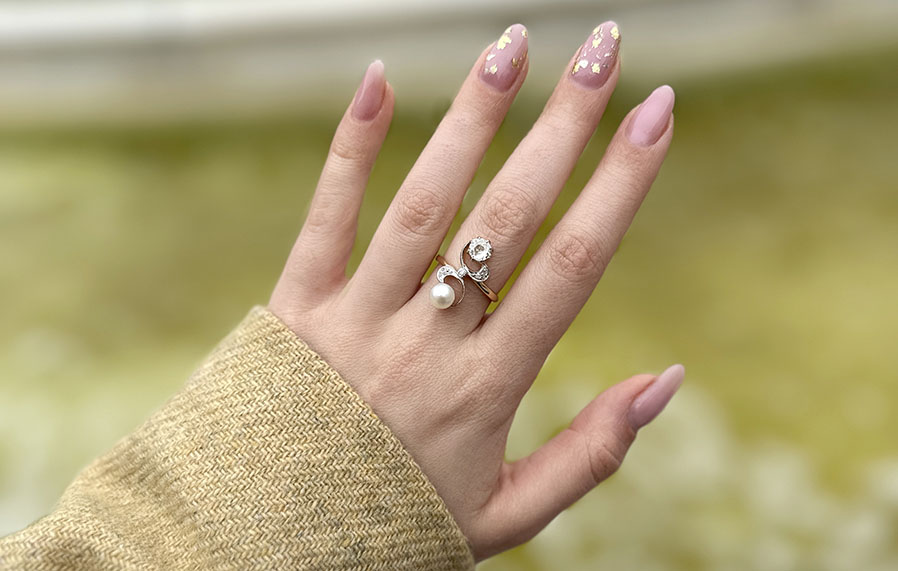
• The Belle Époque for pearl and mother-of-pearl
• The Art Nouveau period for amethyst, opal, enamel, amber, and ivory
• The Art Deco movement for jade, onyx, and topaz
• The 1940s for coral
Is market demand strong?
The valuation of an antique ring must take into account its rarity and the market demand for this type of jewelry. To get an idea of the value of an online jewelry, you can compare prices on resale sites, observe the number of Google results, and the number of pieces of this type for sale on specialized sites. But caution is advised: the resale price and the purchase price of an antique piece of jewelry are, of course, very different! The market price estimate is based on several criteria: the demand for this type of ring from individuals, collectors, and dealers, as well as all the factors mentioned above (quality, period, value of materials, originality, condition).
Use an expert
Using an expert to appraise an antique ring ensures that all these criteria are taken into account in the jewelry's valuation. In the case of antique jewelry, the appraisal is more complex and requires expertise in authenticating jewelry pieces from different periods. To obtain a reliable appraisal, you should not turn to a traditional jeweler, but to a specialist gemologist, an auctioneer, with expert advisors trained in the history of jewelry.
Gemme jewelry stores offer an online jewelry appraisal service based on photos and certificates. Our experts then confirm the initial appraisal by personally examining the antique ring.
Do you own a vintage ring? From the 1940s to the 1990s? Discover our tips for estimating the price of a vintage ring.